How B2B Tech Companies Use Backend Migration to Improve Lead Generation Performance

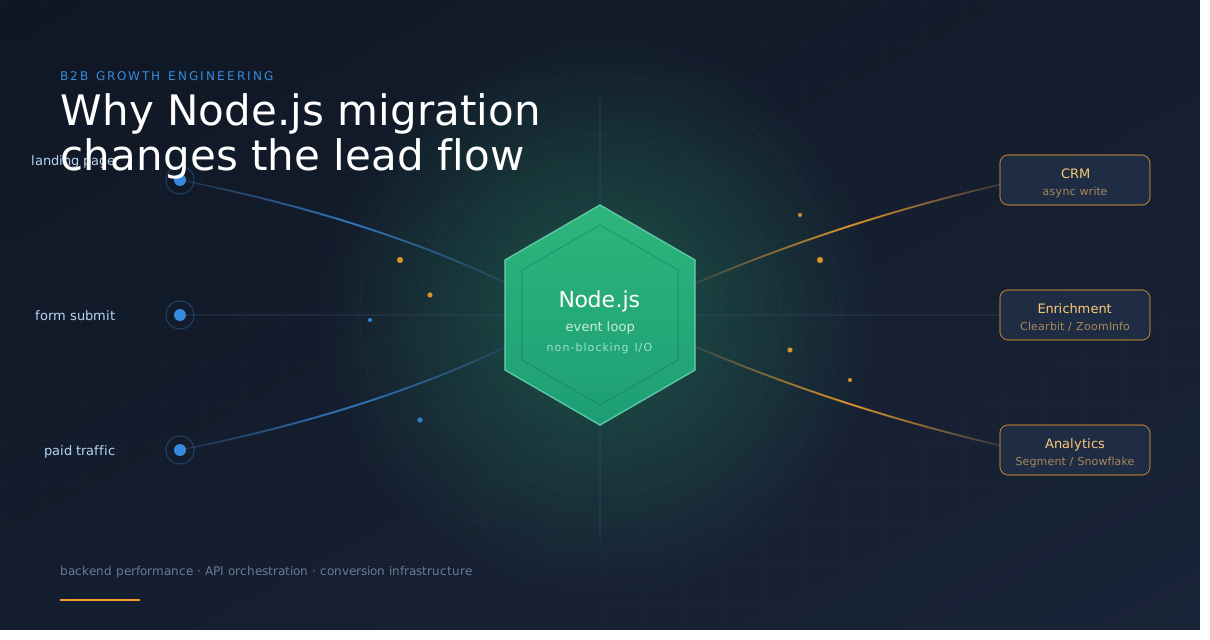
Table of Contents
Backend migrations rarely enter the marketing conversation early. They start in engineering: a legacy monolith that’s slowing down, brittle integrations, or a CRM pipeline that can’t keep up with real-time traffic. But once those issues start affecting landing page response times, attribution accuracy, or form completion rates, the discussion changes tone.
At that point, migration is no longer an infrastructure upgrade. It becomes a constraint on revenue flow.
A useful reference point for how teams approach this shift is https://sysgears.com/tech/nodejs-migration/. It frames Node.js adoption as an architectural decision tied to system behavior, not just a runtime change. That framing matters because backend systems in B2B companies are now directly embedded in how leads are captured, enriched, and routed.
Lead generation now depends on backend responsiveness, not just campaign quality
Most B2B teams still evaluate performance through surface metrics—CPC, CTR, cost per lead. Those numbers matter, but they don’t explain where conversion actually breaks.
A modern lead flow is not a single request. It is a chain of API calls: CRM validation, enrichment through tools like Clearbit or ZoomInfo, analytics tracking, sometimes fraud detection, and personalization logic layered on top. Each step adds latency. Latency stacks.
Nothing visibly “fails,” but conversion rates degrade anyway.
This is where backend performance for B2B marketing becomes a direct growth factor. A 300–500ms delay in form response or personalization can shift behavior enough to reduce conversion rates on high-intent traffic, especially from paid search where attention is expensive and short-lived.
Companies like HubSpot and Salesforce invest heavily in reducing internal API latency for exactly this reason. At their scale, backend delay is indistinguishable from marketing inefficiency.
Why optimization stops working before migration starts
Most engineering teams don’t jump straight into migration. They tune first. They add caching layers, optimize queries, introduce queues like Kafka or RabbitMQ, and try to smooth out bottlenecks.
This works until it doesn’t.
The breaking point is structural. In many legacy systems, marketing workflows are built on synchronous dependencies. A single API call might trigger CRM updates, enrichment, and tracking confirmation before a response is returned to the user. Under load, those dependencies amplify latency instead of distributing it.
At that point, Node.js migration ROI becomes less theoretical. The question is no longer “can we optimize further,” but “can we decouple execution paths so marketing traffic doesn’t block on backend coordination.”
This is also where tradeoffs become unavoidable. Migration introduces short-term instability. Data contracts break if they’re not explicitly mapped. Observability gaps appear when services are split. Teams that ignore this phase usually end up with partial migrations that improve nothing at the business level.
Why Node.js fits API-heavy marketing systems
Node.js is often chosen not because it is universally faster, but because it fits a specific workload pattern: high concurrency, I/O-heavy operations, and orchestration across multiple services.
Modern marketing stacks are exactly that. A typical API performance marketing stack connects tools like Salesforce, HubSpot, Segment, Snowflake, and multiple enrichment or personalization APIs. The backend is mostly coordination, not computation.
Node.js handles that coordination efficiently because of its non-blocking event loop. Requests don’t stall the runtime while waiting on external services.
That said, it does not solve everything. Slow third-party APIs remain slow. Poor data models remain poor. Node.js simply prevents backend execution from becoming the bottleneck on top of those limitations.
Companies like PayPal and Netflix adopted Node.js for similar reasons: concurrency and API orchestration, not raw compute.
What changes in the marketing stack after migration
Before migration, marketing systems rely heavily on compensation mechanisms. Caching layers serve stale personalization data. Batch jobs sync CRM updates every few minutes. Analytics pipelines reconcile events after the fact.
These patterns hide backend weaknesses, but they also introduce delay and inconsistency.
After migration, those compensations shrink or disappear. The backend can support real-time interactions directly, which changes system behavior in subtle but important ways.
CRM updates become immediate instead of queued. Attribution pipelines rely less on reconciliation logic. Experimentation cycles shorten because event data is available without batch delays.
This is also where outsourced Node.js migration projects often underperform. A typical Node.js migration vendor may successfully rewrite services but fail to map dependencies across the full marketing system. The result is faster APIs that still sit inside slow end-to-end flows.
How migration reshapes actual lead flows
A standard B2B SaaS funnel looks simple: landing page, form submission, CRM entry, follow-up sequence. Under the hood, each step triggers multiple backend operations.
In legacy systems, these operations are often synchronous. A form submission waits for enrichment, CRM validation, and tracking confirmation before responding. That delay is enough to increase abandonment rates, especially on paid traffic where intent is high but tolerance is low.
After migration, the structure changes. The user-facing request is decoupled from backend processing. The system returns immediately while enrichment, scoring, and analytics run asynchronously.
The backend workload does not disappear. It just stops blocking the user.
At scale, this shift is what improves conversion rates—not because the system is “faster,” but because users are no longer waiting for backend coordination to finish.
Vendor selection is about system understanding, not implementation speed
Choosing a Node.js migration vendor is often treated as a development procurement decision. That is too narrow.
The real challenge is understanding how marketing systems depend on backend behavior. A CRM webhook, an analytics event pipeline, and a personalization engine are not isolated services. They form a tightly coupled execution graph.
A capable vendor doesn’t just rewrite services in Node.js. They map synchronous dependencies, decide what becomes event-driven, and define how data consistency is maintained across systems.
Without that, migration produces isolated performance gains but no measurable impact on conversion or pipeline velocity.
The risks that actually break migration projects
Downtime is rarely the real issue. The more common failure is broken assumptions hidden inside the system.
Marketing tools often depend on implicit guarantees: ordered events, immediate webhook responses, or consistent timestamps across systems. Legacy architectures sometimes satisfy these constraints accidentally. Migration exposes them.
Timing is another risk. Running migration during active acquisition campaigns can distort attribution data for weeks. Even short inconsistencies in event tracking can break reporting confidence across sales and marketing teams.
The most common failure pattern is partial migration. Teams stop once individual services show improvement, without validating full funnel behavior. That creates the illusion of success while conversion metrics remain unchanged.
What actually improves after stabilization
Once migration is fully complete and system behavior stabilizes, the improvements are less about speed and more about predictability.
Lead routing becomes consistent because data arrives in real time instead of batch intervals. Sales teams work with cleaner CRM records. Marketing teams run experiments without waiting for delayed data propagation.
There is also a less visible shift: iteration speed. When backend systems no longer block experimentation, teams stop designing campaigns around technical constraints that no longer need to exist.
Backend architecture is now part of growth engineering
Backend migration is no longer just an engineering milestone. In B2B companies, it is part of how growth systems are built.
Organizations that treat backend architecture as part of marketing execution—not just infrastructure—end up with faster feedback loops and more stable conversion systems. Not because everything runs faster, but because nothing important waits on synchronous bottlenecks anymore.
The impact is not theoretical. It shows up in how quickly teams can test, adjust, and scale lead generation systems without rebuilding the backend every time marketing strategy changes.
Share this article