6 Best GDPR-Compliant Web Analytics Software in 2026


Table of Contents
Tracking how visitors interact with your pages has become a non-negotiable part of running any online presence. From understanding which traffic sources drive conversions to pinpointing where users drop off in a funnel, the right platform can turn raw data into actionable growth decisions.
But the landscape keeps shifting. Privacy regulations tighten every year, cookie-based tracking loses ground, and AI-powered features reshape what analytics dashboards can deliver. Choosing between a free tool and a premium suite often comes down to trade-offs between depth, compliance, and ease of use.
This guide breaks down seven leading platforms across pricing, privacy compliance, integrations, and analytics depth. Whether you run a small blog or manage enterprise-level traffic, you'll find a clear breakdown of what each option brings to the table in 2026.
Matomo
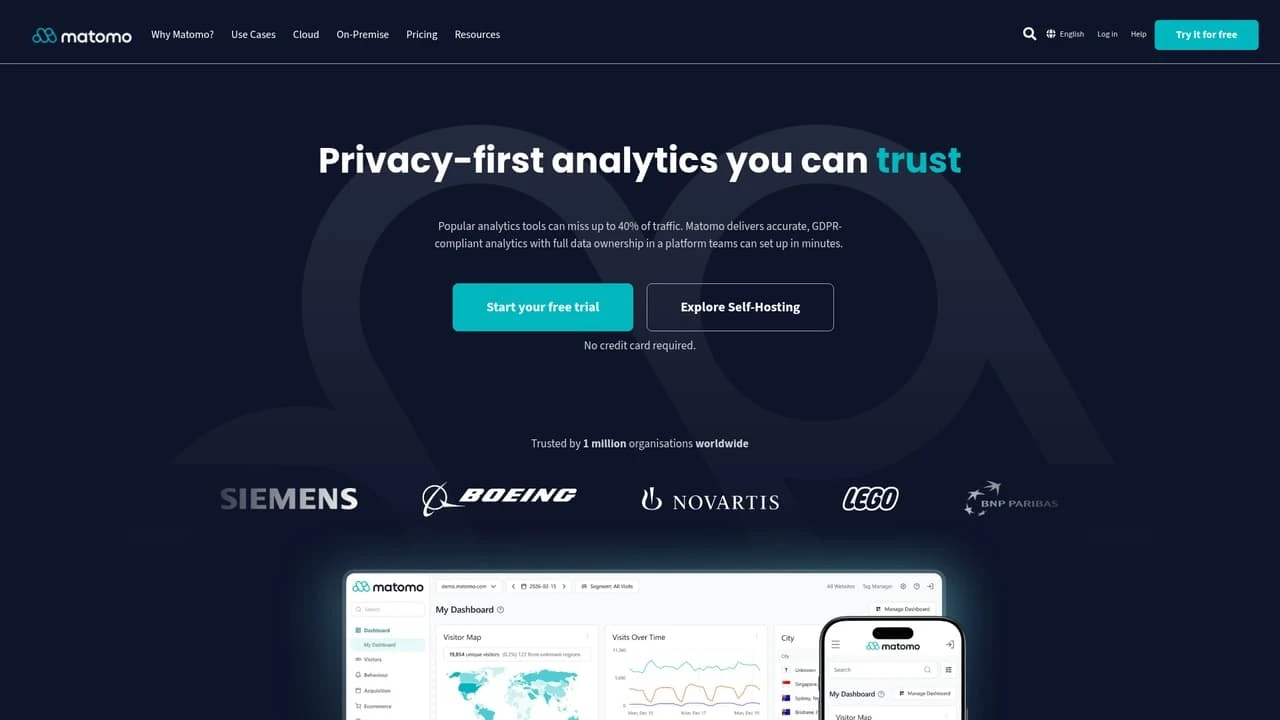
Matomo gives organizations full data ownership while delivering a feature set that rivals enterprise-grade platforms. Over one million organizations worldwide rely on it, and its flexibility lets you choose between cloud hosting and self-hosted deployment at no cost.
The analytics suite covers pages and traffic sources, conversions, events, funnels, flow analysis, segmentation, A/B testing, heatmaps, and session recordings. Every data point arrives unsampled, which means your reports reflect actual visitor behavior rather than statistical estimates. A standout capability in 2026: Matomo tracks AI-driven traffic from assistants, agents, and chatbots, a gap most competitors still ignore.
Privacy sits at the core of the platform. Matomo operates with cookieless tracking, data anonymization, granular access controls, and audit logs. It holds ISO 27001:2022 certification and aligns with GDPR and other global privacy frameworks. Unlike tools that lose visibility when visitors reject consent banners, Matomo captures data without relying on cookies or being blocked by ad blockers.
Setup takes minutes. You add a single JavaScript line to your site, and integrations with WordPress, Google Tag Manager, and over 100 other platforms extend functionality without heavy development work. The 21-day free cloud trial requires no credit card, and the self-hosted edition remains free forever.
Dedicated experts provide configuration assistance, training, and troubleshooting. Transparent pricing with clearly defined tiers means you won't encounter hidden charges as your traffic scales up.
Google Analytics
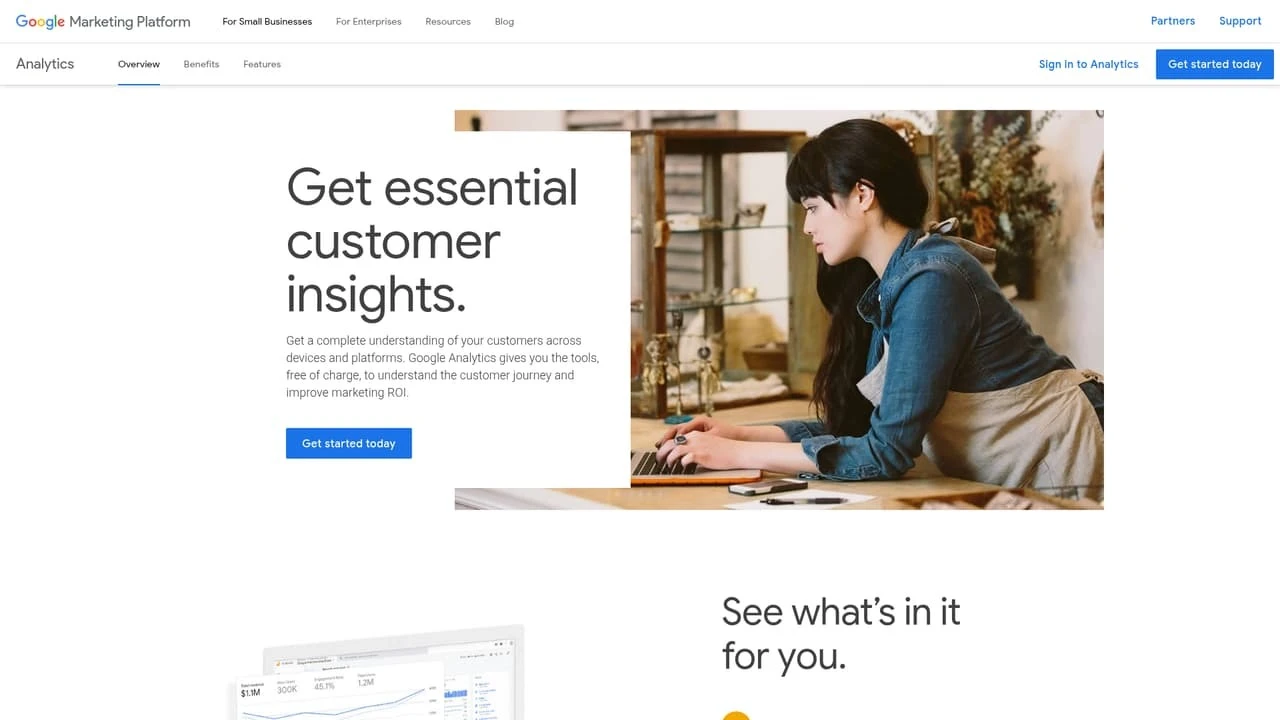
Google Analytics remains the most widely adopted analytics platform, largely because it costs nothing. For teams already embedded in the Google ecosystem, the native connections to Google Ads and Search Console create a seamless reporting loop.
Cross-device and cross-platform tracking stitches together customer journey data from websites and mobile apps into a unified view. Google's machine learning models surface trends automatically, predict churn probability, and identify high-value audience segments before you dig into the data manually.
Reporting feels intuitive for beginners. You can build, customize, and share dashboards without touching code. One documented case, 412 Food Rescue, cut their reporting time by 50% after migrating to the platform's automated workflows.
Where does it fall short? Data sampling kicks in on high-traffic properties, which can skew results for large sites. Privacy-conscious organizations may also hesitate, since the platform processes data on Google's infrastructure and requires cookie consent banners in regions governed by GDPR. That said, for small to midsize teams seeking a zero-cost entry point with robust attribution modeling, it remains a compelling default choice.
PostHog
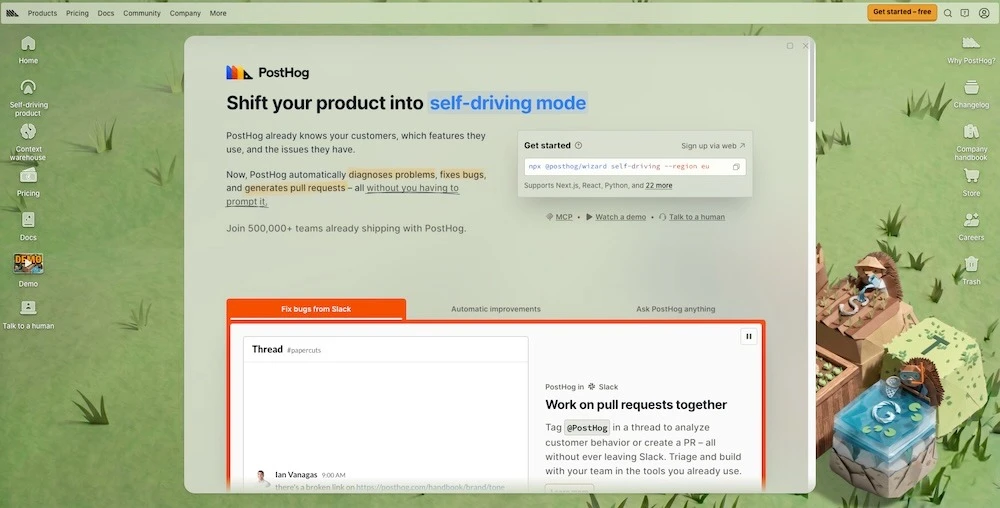
PostHog positions itself as an all-in-one product analytics suite built for engineering teams. The open-source foundation means you can self-host the platform or use their managed cloud offering depending on your infrastructure preferences.
The feature list goes beyond traditional pageview tracking. Product analytics, session replays, feature flags, A/B testing, and user path analysis all live under one roof. Developers appreciate the event-based tracking model, which captures granular interactions without requiring a separate tag management layer.
Pricing follows a generous free tier model that includes a meaningful volume of events each month. Paid plans scale based on usage, so early-stage startups can access enterprise-grade capabilities without committing to large contracts upfront.
- Install the snippet or SDK in your codebase
- Define custom events tied to product milestones you care about
- Build funnels and retention charts directly from your event stream
GDPR compliance tools exist within the platform, including data anonymization options and the ability to self-host for complete data sovereignty. The community-driven development cycle means new features ship frequently, often sourced directly from user feedback on GitHub.
Plausible.io
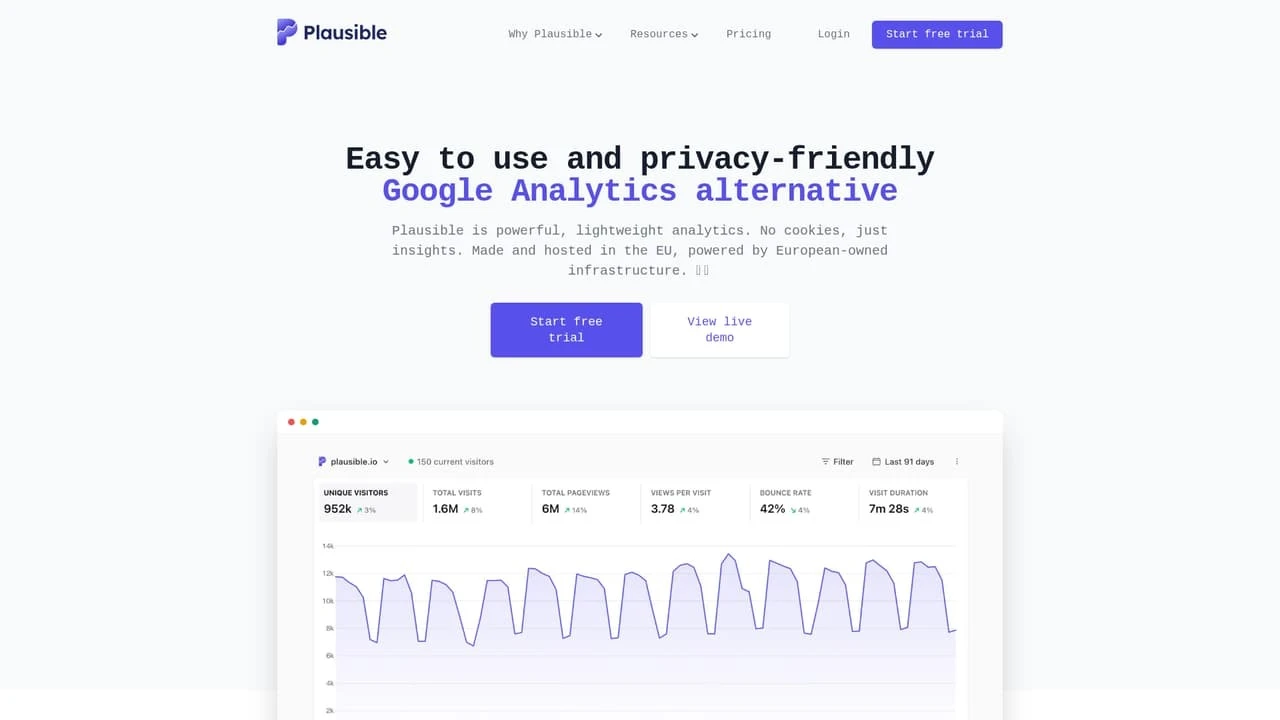
Everything you need sits on a single page. Plausible strips analytics down to the essentials: traffic sources, top pages, locations, devices, and trends, all visible within 60 seconds of loading the dashboard. No menus to navigate. No custom reports to build.
The privacy architecture goes further than most alternatives. Plausible processes zero personal data, uses no cookies, deploys no persistent identifiers, and avoids cross-site or cross-device tracking entirely. Visitor data stays exclusively on European servers and never leaves the EU, making GDPR compliance effortless rather than an afterthought.
Performance deserves attention too. The analytics script weighs in at roughly 45 times lighter than Google Analytics, saving approximately 135KB of bandwidth per visitor. For a site with 100,000 monthly visitors, Plausible estimates this translates to about 4 kg of CO2 saved annually.
The team behind it has stayed independent and bootstrapped since 2018, now ten people strong with over 19,000 paying customers. You can import your historical Google Analytics data during migration. A 30-day free trial starts without requiring a credit card, and paid plans begin based on monthly pageview volume (up to 10,000 pageviews included in the starter tier). The entire codebase remains open source, eliminating vendor lock-in.
Fathom Analytics
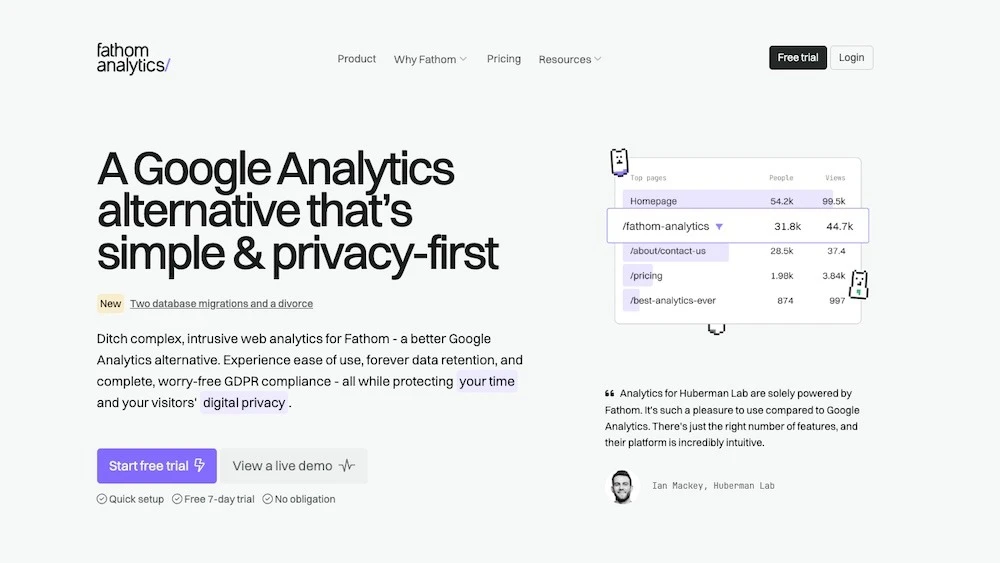
Fathom Analytics caters to website owners who want accurate traffic data without compromising visitor privacy. The platform operates completely without cookies, which means you can skip consent banners in most jurisdictions and still capture meaningful insights.
Speed defines the user experience here. The dashboard loads fast, displays key metrics upfront, and avoids the complexity that bogs down more feature-heavy platforms. You see visitors, pageviews, bounce rate, average time on site, and top referral sources without clicking through nested menus or configuring report parameters.
What makes Fathom distinctive among privacy-first alternatives is its approach to compliance. The platform routes data through EU-based infrastructure and provides built-in mechanisms for GDPR, CCPA, and ePrivacy alignment. Setup takes just a few minutes: paste a lightweight script into your site header, and data starts flowing immediately.
Pricing uses a straightforward monthly subscription model based on pageview volume. No per-seat charges. No surprise overages. Teams that need simple, reliable analytics without the overhead of enterprise platforms tend to find Fathom a natural fit, especially content publishers and SaaS companies focused on clean, privacy-respecting measurement.
Adobe Analytics

Adobe Analytics targets enterprise teams managing complex, multi-channel ecosystems where surface-level pageview data simply isn't enough. The platform connects web, mobile, and product interaction data into a unified analytics layer purpose-built for large organizations.
AI-powered insight extraction sets Adobe apart from lighter tools. The platform identifies anomalies, surfaces hidden audience segments, and automates pattern detection across billions of data points. Attribution modeling goes deep: you can measure conversion drivers across paid, organic, email, and offline channels within a single interface, then activate those findings without exporting data elsewhere.
How does governance work at scale? Adobe provides granular permission controls, automated data processing workflows, and consistent standards across every platform your team touches. This reduces reliance on IT teams for routine analytics tasks and keeps sensitive customer data protected under robust compliance frameworks.
The trade-off is clear. Adobe Analytics demands significant budget commitment (pricing requires a custom quote) and a steeper learning curve than simpler alternatives. Organizations already using the Adobe Experience Cloud benefit from tight integrations, but smaller teams may find the platform's depth exceeds their needs. For enterprise operations with dedicated analytics staff, few platforms match its breadth.
Mixpanel
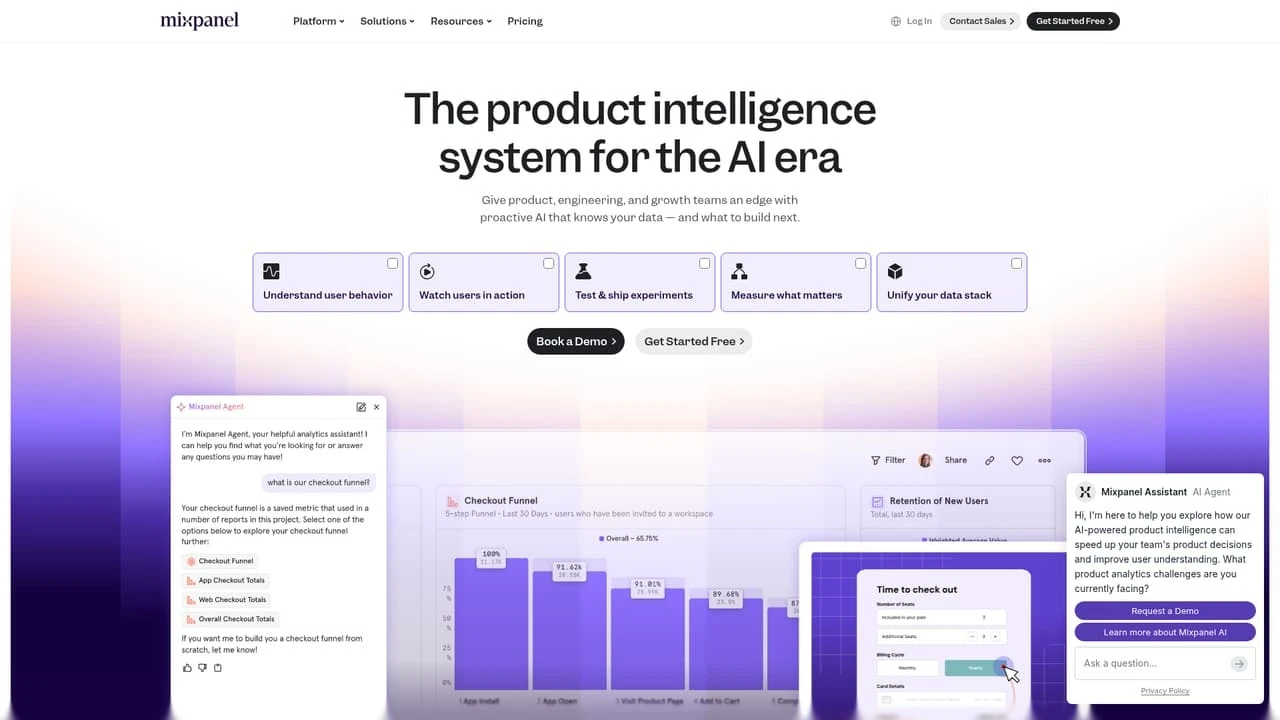
Mixpanel delivers sub-second query performance even at billions of monthly events, making it a favorite among product teams that need answers fast. You can explore user behavior trends, conversion patterns, and retention curves without waiting for a data team to pull reports.
The AI layer, called Mixpanel AI, works proactively. Ask questions in natural language and receive actionable answers. The system also surfaces insights before you ask, flagging unusual drops in engagement or unexpected spikes in feature adoption.
Three capabilities stand out for product-led organizations:
- Metric Trees map your KPIs to their underlying drivers, so you can trace exactly what influences each number
- A/B testing integration measures experiments against real product metrics rather than vanity pageview counts
- Session replays and heatmaps provide visual context behind the quantitative data
Mixpanel connects natively to BigQuery, Segment, Redshift, and reverse ETL tools, so your data flows freely without vendor lock-in. A community of 12,000+ practitioners supplements the official documentation, tutorials, and free courses.
On the compliance side, Mixpanel holds SOC 2 Type II and ISO 27001 certifications, supports HIPAA-ready configurations, and offers SSO/SAML with detailed audit logs. The pricing model scales with event volume, and a generous free tier lets smaller teams validate the platform before committing budget.
FAQ
How do you choose the right analytics tool for your website?
Start by defining what you actually need to measure. E-commerce conversion funnels demand different capabilities than a content blog tracking pageviews and referral sources.
Evaluate three factors: your monthly traffic volume (which affects pricing), your team's technical skill level, and your privacy compliance requirements. A tool that fits a 10-person startup won't necessarily scale for an enterprise with dedicated analysts.
What does a website analytics platform typically cost?
Pricing models vary significantly. Several platforms offer generous free tiers or fully free editions, while enterprise solutions require custom quotes that can reach thousands per month.
Most paid tools base their pricing on monthly event volume or pageview counts. Watch for hidden costs like per-seat charges, premium support fees, or overage penalties that inflate your bill as traffic grows.
Can you use analytics tools without cookies?
Yes. Multiple platforms now operate entirely without cookie tracking, which eliminates the need for consent banners in most jurisdictions. These tools rely on privacy-friendly techniques like aggregate data modeling.
Cookieless analytics typically simplifies GDPR and ePrivacy compliance. The trade-off is that some individual user tracking features become unavailable, though most platforms compensate with robust aggregate-level insights.
What is the difference between web analytics and product analytics?
Web analytics platforms focus on traffic sources, pageviews, bounce rates, and acquisition channels. They answer the question: "Where do my visitors come from?"
Product analytics tools go deeper into user behavior after sign-up. They track feature usage, retention cohorts, and conversion funnel performance. Many modern platforms blur this line by offering both capabilities in a single dashboard.
Why does data privacy matter when selecting an analytics tool?
Privacy regulations like GDPR and CCPA carry steep penalties for non-compliance, reaching up to 4% of annual global revenue in some cases. Choosing a platform with built-in compliance features reduces your legal exposure.
Beyond legal risk, privacy-respecting tools tend to capture more accurate data. When visitors trust your site and don't block tracking scripts, you get a fuller picture of actual behavior rather than a skewed sample from users who accepted cookies.
Share this article